Wednesday, October 11, 2006

Rain


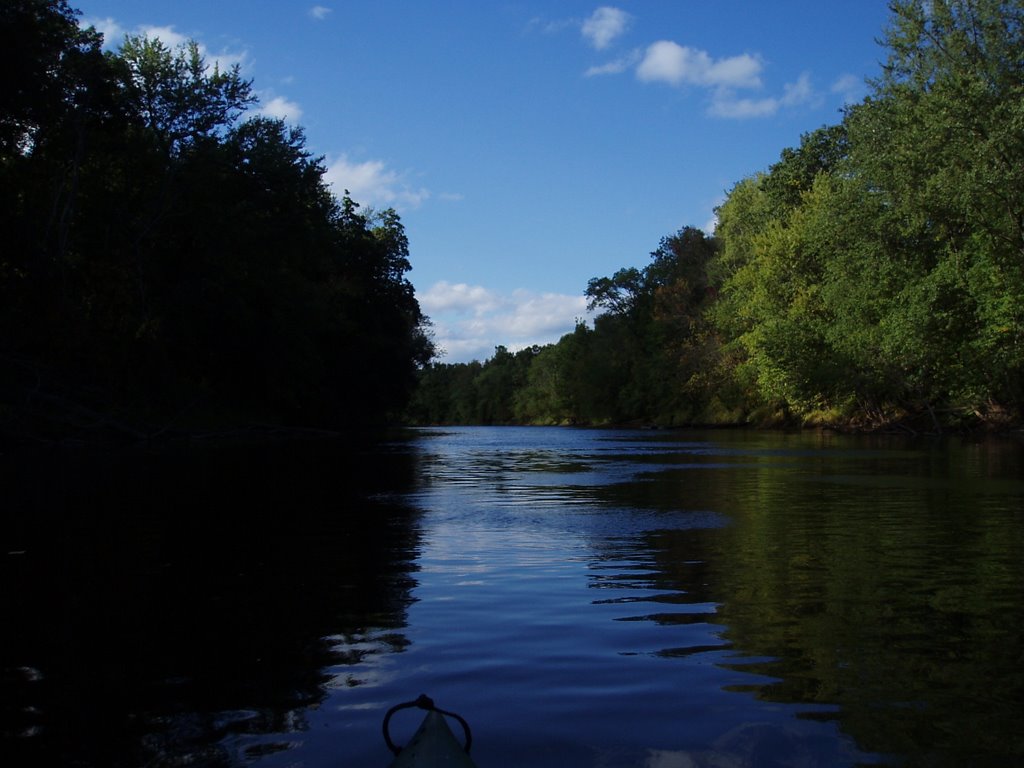
A much needed rain is currently falling, lightly, in the Farmington Valley. I am sitting in my kitchen listening to the drops hit the concrete patio, gutters, leaves, lawn, trying to capture each different sound and each individual drop. I know of few people who can't find a way to appreciate the sound of rain, its languid quality, the way that it induces gentle melancholy stillness and contemplation. One of my greatest joys is to be hunkered down in a warm sleeping bag listening to the drops tapping the tent fly on a cold fall evening with light fading and the winter darkness making itself known as the first of all the seasonal change at that time of year. It is an enveloping kind of darkness that feels, as it settles, like it will not yield to daylight. Rather, it creeps into every space in the woods with a dreadful permanence , and then it relents a bit as sleep takes over and a dreamworld prevails.

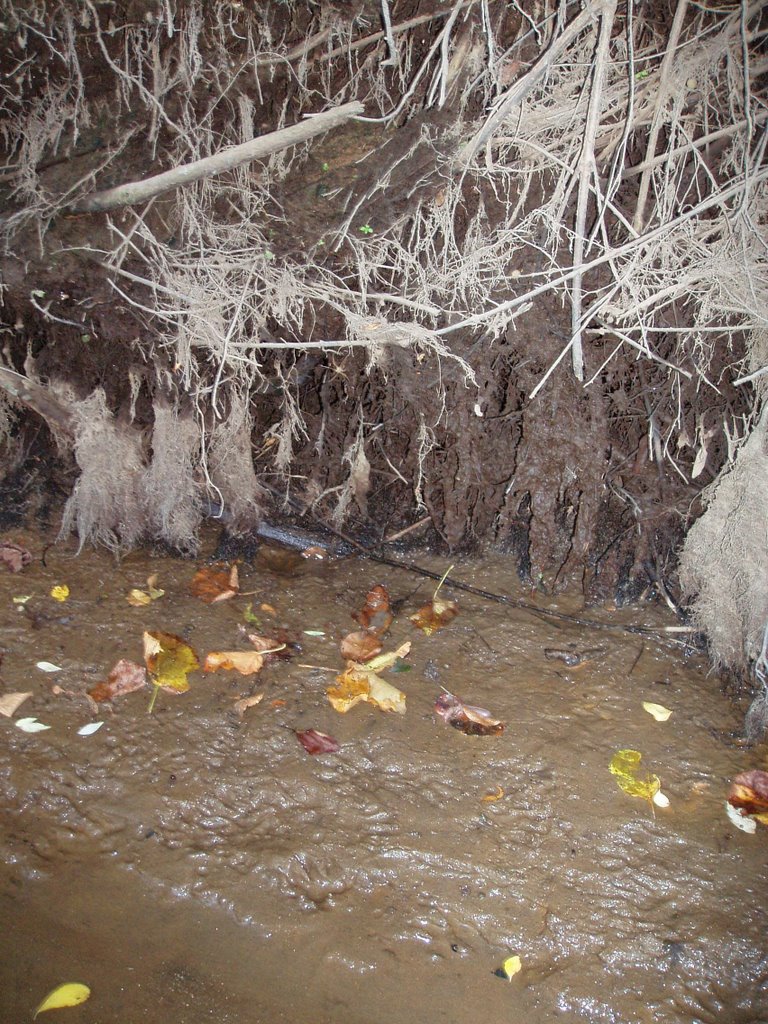
The rain will help restore the river level which has become disturbingly low. We have had a mild drought since mid-August, although that term is lost on most New Englanders at this time of year as there is little sign to indicate its presence. With cooler days, lawns don't brown the way they will in summer drought and leaves are beginning the process of senescence as it is. Water is not the precious resource here in the East that it is in Nevada, Utah, New Mexico, and Southern California. We take it for granted and we use it in excess. But the soil, the groundwater, does "know" that dry conditions have prevailed. The water table is below the level of the river and little, if any, recharge is occurring. In addition, the Metropolitan District which controls the major reservoirs is reporting that levels have dropped by about 1% in the past week alone. The temptation to hold back flow at the dams must be great and, of course, this would lead to even lower flow in the river.

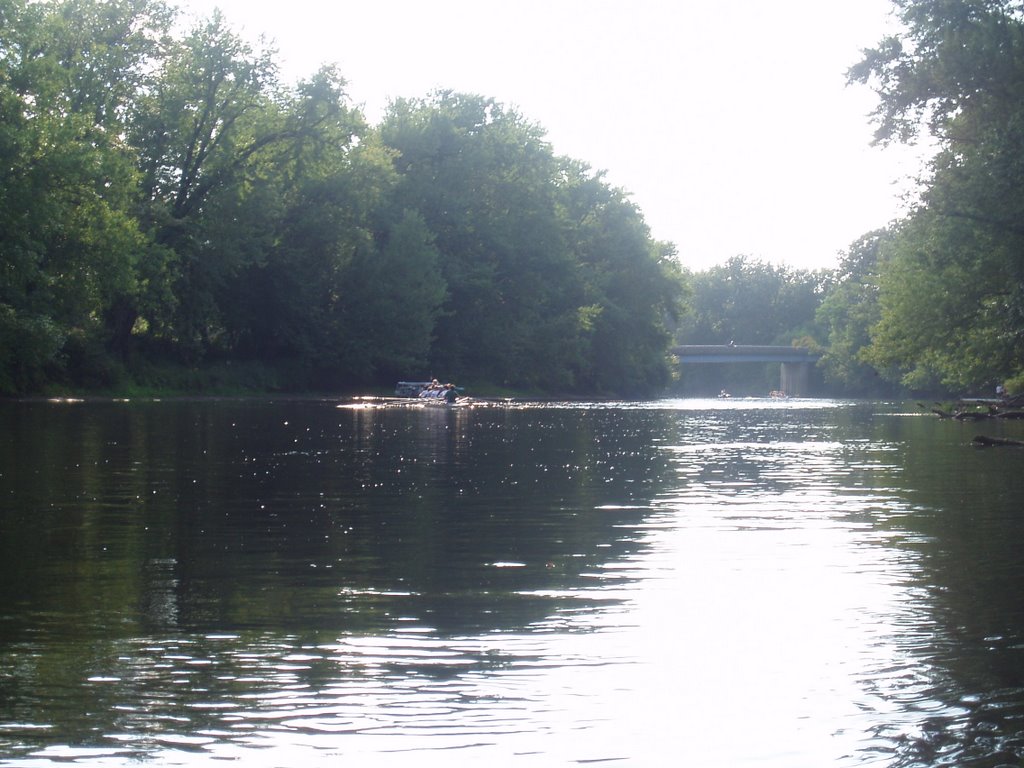
The level has not been down to the point where my kayaking has been impeded, but I think of all the trout and large mouth bass I watched over a month ago. They are squeezed into an ever decreasing volume of water and, for the trout in particular, must seek the few deeper pools and eddies where cooler oxygen rich water can be found at the bottom. Imagine being taken out of a large hotel suite and crammed into a cluttered college dorm room with a few other people. It can't be much better than that for the fish.

So before Winter begins to lock up ground flow, I want it to rain and rain and rain. In the meantime, paddle on, paddle on, paddle on.

Monday, October 09, 2006

Pets and paddles


Today was a gloriously warm and clear celebration of Columbus who might be remembered most appropriately not for discovery (he really didn't), but for being bold enough to bumble his way across miles of monotonous sea in an effort to please a king and queen and to satisfy his boyhood urge to explore.

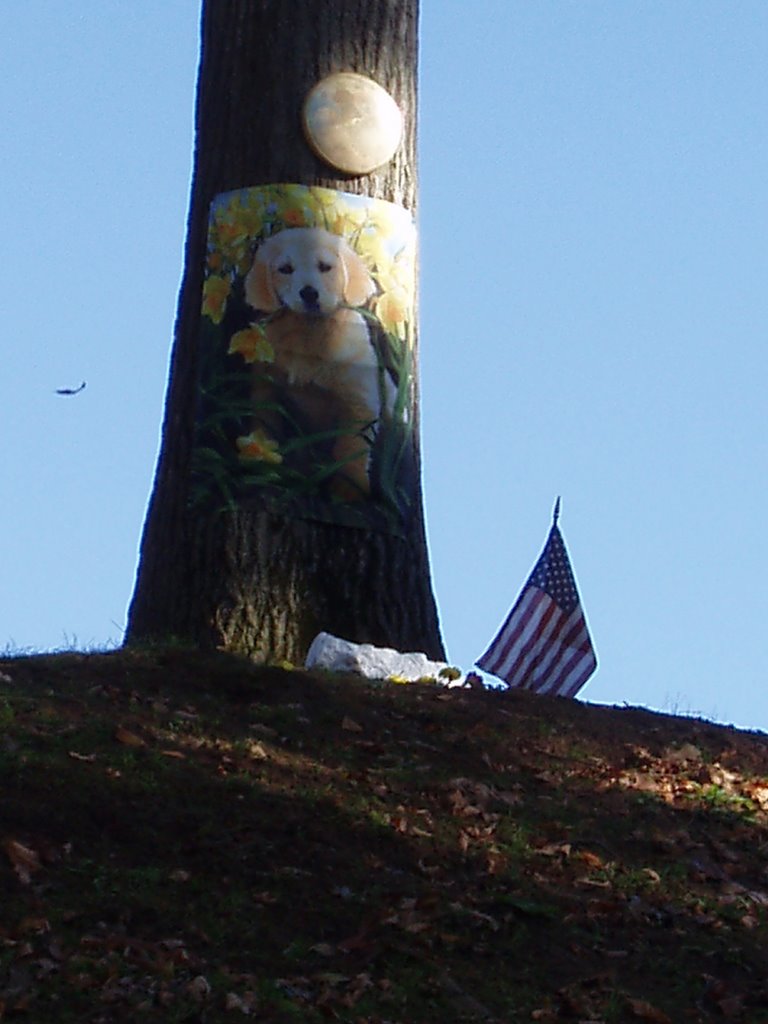
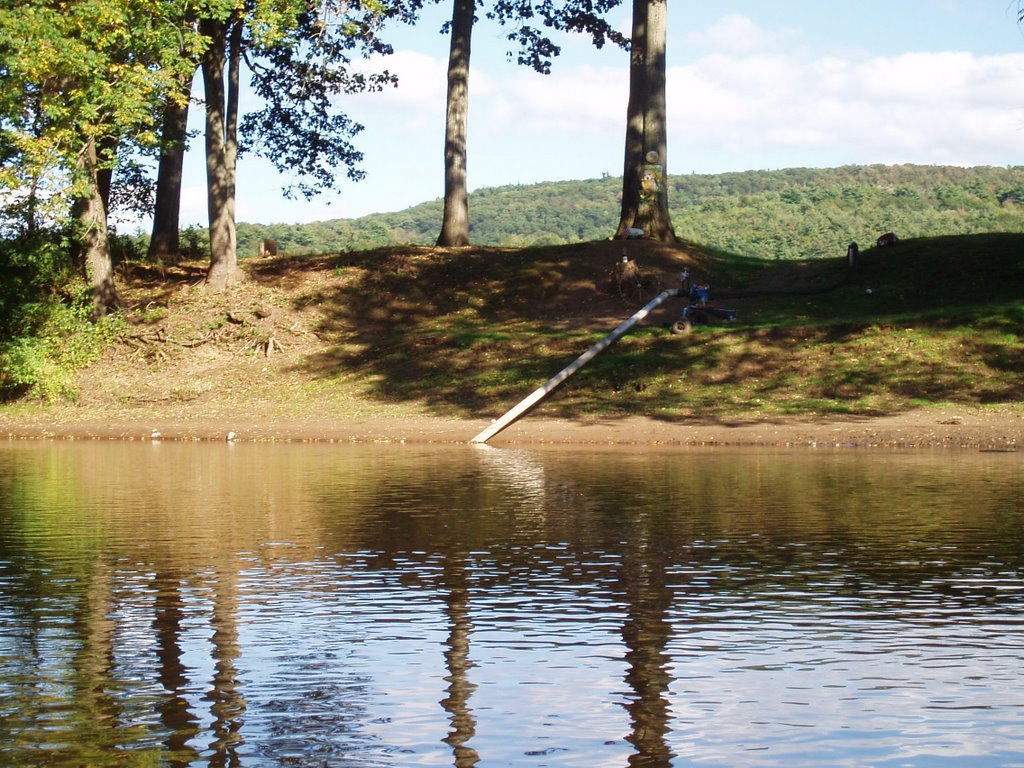
I drove down to the Pinchot Sycamore put-in again as I found that I was handed some time I did not expect. At a spot that I had previously lamented questionable use of water, I was heartened to see a rather eleborate memorial that had been erected for a favorite pet. The dog in whose memory the shrine was created must have been one of those golden retrievers that lived for splashing and romping in the shallows of the river's edge. I soon found myself thinking of our own aging dog, Belle. She has been with us for fourteen years. Belle came to us via an SPCA adopt-a-pet effort in Philadelphia. When we become her new family, she was just about two years old, puppy-like in demeanor, with an unusual habit of jumping into your lap when seated much like a cat. Not so idiosyncratic for a small breed, Belle was a forty plus pound cross between a Gordon and English Setter with some other mixes tossed in for curiosity. Belle joined our family of pets that included, at the time, two cats, a rat, and our first dog, Honey.


Honey was a retriever mix who loved to chase tennis balls. He would often continue running after a thrown or kicked ball even when his tongue was hanging out as far as it could. When thoroughly exhausted, he took the ball and dragged himself toward some shade to keep me from throwing it again - he knew his instinct to run would overwhelm his desire to rest. Interestingly, Belle had no interest in chasing balls. In fact, if you put a ball in her mouth she would respond by dropping it immediately and not give it a second glance.

After having been a member of the family for several years, Belle was present in our bedroom when Honey was put to rest by our kind veterinarian who made house calls. Honey had developed a brain tumor and quickly become too ill to support himself. At the vet's suggestion, we let Belle sniff Honey's body for a few minutes so that she would not be confused by his absence. We had all taken the day off from school and work and I later took Honey's remains to the SPCA for cremation.

The next morning we left Belle and the cats in decent spirits as we left for school and work. When we returned home later that afternoon we were stunned by what we saw and I became convinced that animals are very emotional and intelligent beings. Up in our room, in the middle of the bed, in the very spot where Belle had said "goodbye" to Honey, there sat a tennis ball. Honey had not been interested in tennis balls during the last few days of his life and they were all stored in a box downstairs in the mudroom off the kitchen. At some point during the day, Belle had retrieved a ball and brought it up to the bed as a memorial. It was the only instance of her holding a ball in her mouth for more than a brief second.

Now, in these rapidly advancing autumn days, Belle is reaching her end. She is a beautiful animal despite the arthritis which has all but crippled her rear legs. I wondered as I stopped to photograph this memorial, what memories the retriever had created for its family. Was her loss sudden, or did she live a full and contented life? Paddle on, paddle on, paddle on.
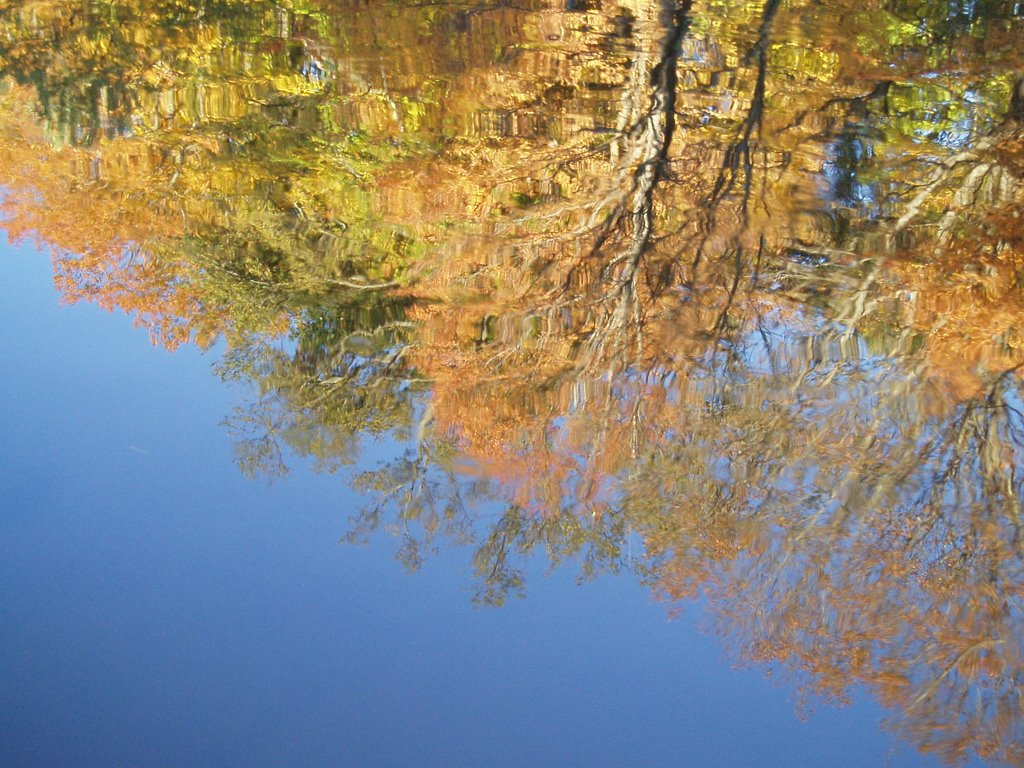
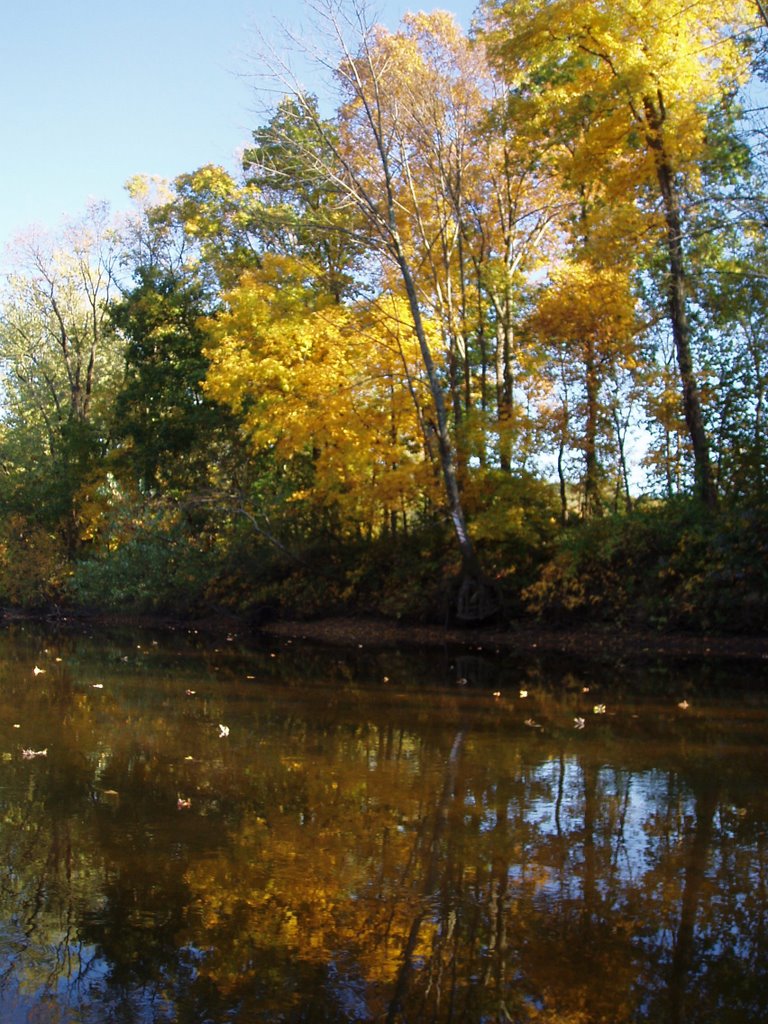
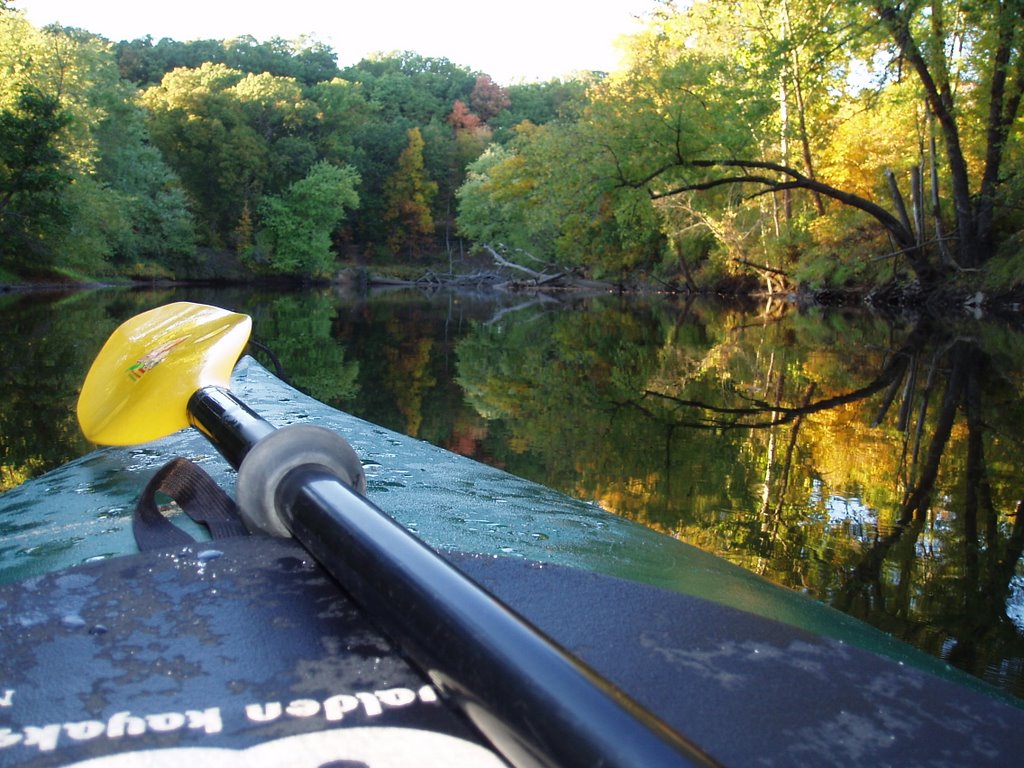
The leaves are changing by the day, now. Despite the near 75 degree warmth, I felt cool fall air whenever I moved the kayak out of the sun toward the shaded bank. The ground is now giving up considerable stored heat to the chilly night air and frosts are only days away. Not wanting to rush this beautiful time of year, I thought, today, about paddling in a snow squall and all the rigors of a New England winter which are upon us once again. But fall has just begun and I have many, many hours to spend on this mile of river before my attention will turn toward cross-country skis and blizzards.


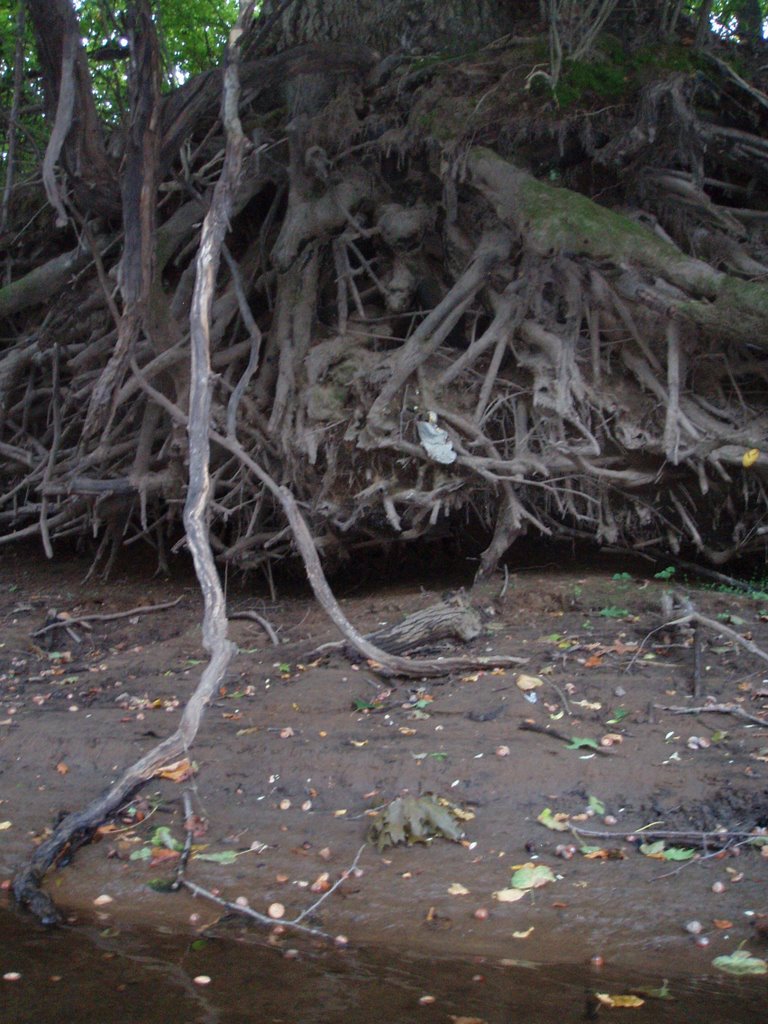
Yesterday's reflections have yielded to the anticipation of full fall color and foliage senescence that opens views into the wooded areas along the banks. Perhaps the heavy acorn crop will attract plenty of deer which will have less cover and be more visible. The tracks that I saw today in the exposed sand of river bottom are telling a story of change and preparation. Autumn moves on inexorably and autumn is, indeed, a season of change.

Sunday, October 08, 2006

Reflections


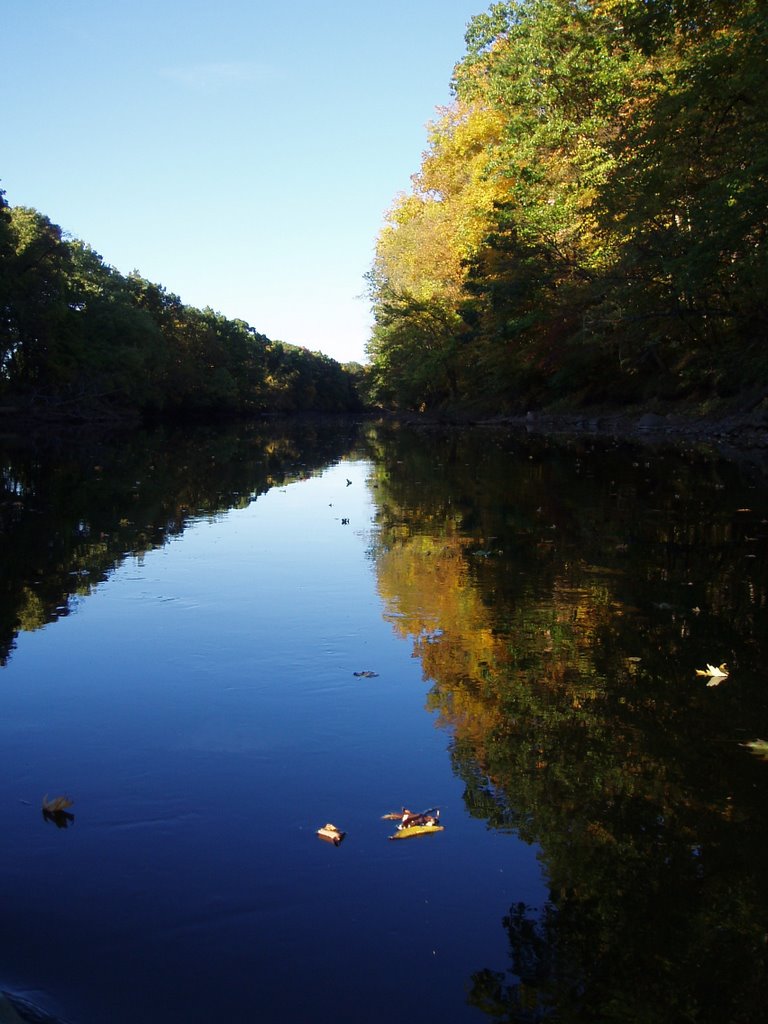
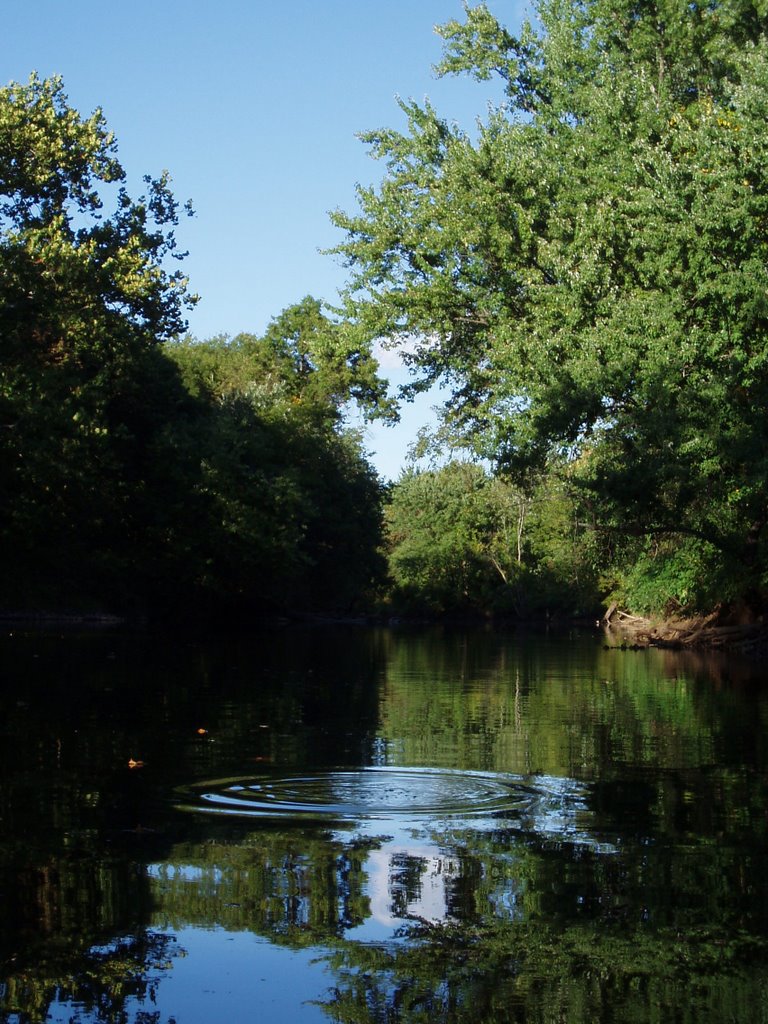
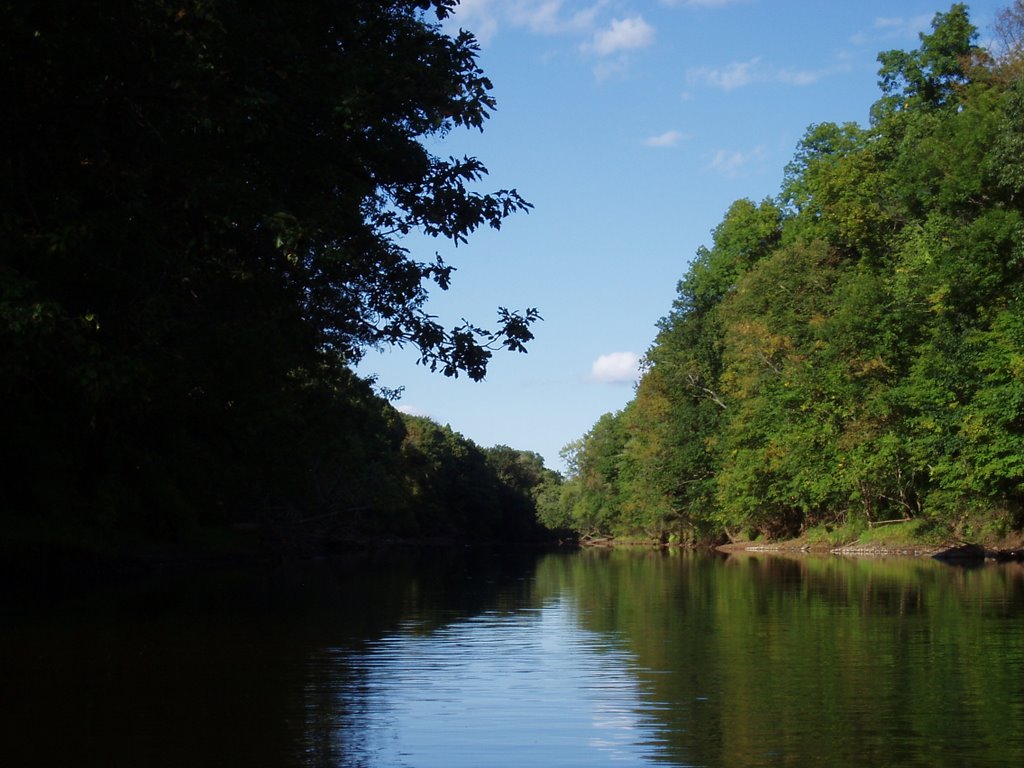
When I saw the glassy surface of the river, the warm red light from the evening sun, and the deepening color in the trees, it came to me that I should write about reflections this evening. And of course, it was only a matter of minutes before I found myself singing the Supremes' song and getting stuck on the philosophical irony in the line "...reflections of, the way life used to be...". The reflection is of the present, not the past. The way life used to be is the way it is now, the way it was in ages past, and the way that it will continue to be. Sure, we have changed the means by which we interact with our world, but the substance of the interactions is still the same. We spend many hours engaged in a struggle and look desperately in the corners to find brief moments of real joy. Time will distort our recollection of the personal past, but the reflection continues to be of the present. When we were children, things were not different, we simply perceived a difference because our experience was much more innocent. Melancholy nostalgia, something toward which I gravitate often and heavily, is an illusion. The reality of those previous experiences of many days or years ago is very similar to the reality of this moment. The reflection is doing its best to give us a stark look at reality.


My mind wandered as I floated downriver and photographed the colors and the patterns in the ripples of water. My mentor, Sigurd Olson, came to mind as did his wonderful reflections of the many years he spent in the wilderness of the Quetico-Superior region which he helped to preserve. Olson wrote as though his pen were a paddle and each movement was pulling him forward to some clear, decisive, and simple destination. His ideology was based upon reflection; a deep contemplative turning of ideas and opinions which made their way into each vignette he crafted about his world. I never met Sigurd Olson, yet I have paddled right alongside him in New Hampshire, Maine, Ontario, Quebec, Connecticut, Vermont and, most importantly, in my imagination where kindred spirits find their strongest bonds. I think of all the canoe partners and fellow voyaguers with whom I have had the joy of seeing water's reflections of mood and spirit and smile. Paula, Heidi, Gabe, Kern, Lem, Dan, Jeff, Anna, Anne, Lizzie, Alexa, and many others, have kept me company in the corners where I find joy.


Try this sometime. On a calm clear day when you are standing at water's edge and the still surface reflects the landscape with surreal precision, turn and put your back to the water, bend over and gaze at the surface of the water with your head up-side-down looking between your legs. I was pleasantly stunned by the deception of mind that this little "trick" plays. Enjoy it if you get the chance!!


A haiku:

Reflecting water
Is a home for my journey.
I am never lost.


I am fascinated by the distortions of the reflections more than the perfection of the still water.

Wednesday, October 04, 2006

A Little Whitewater!


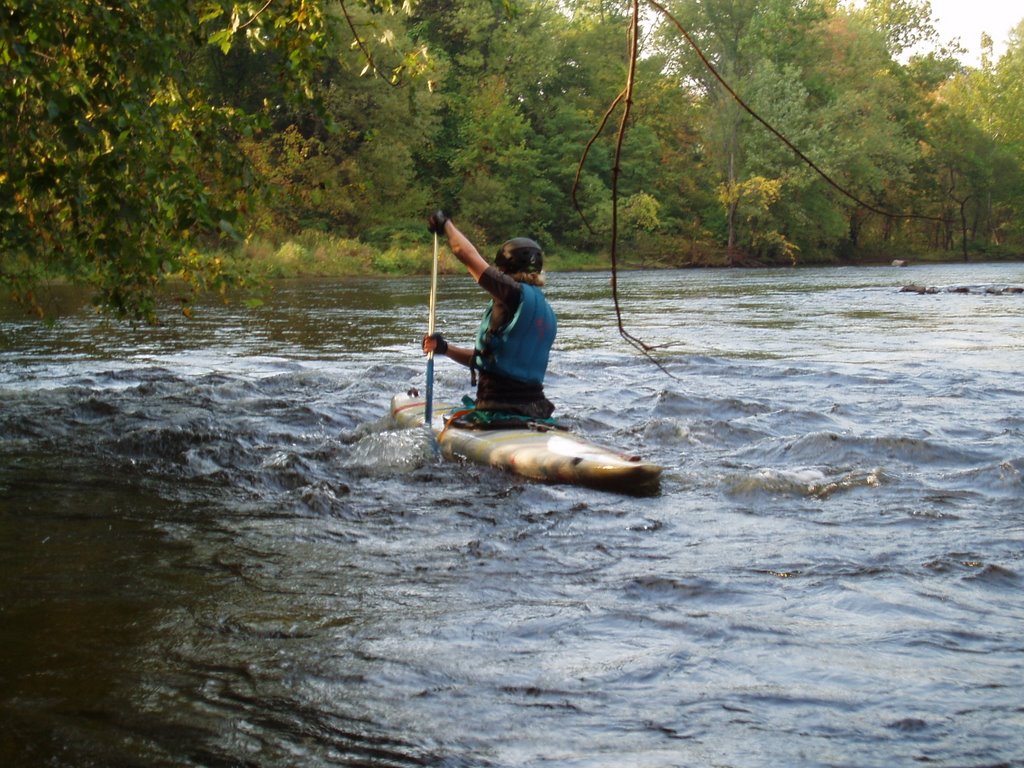
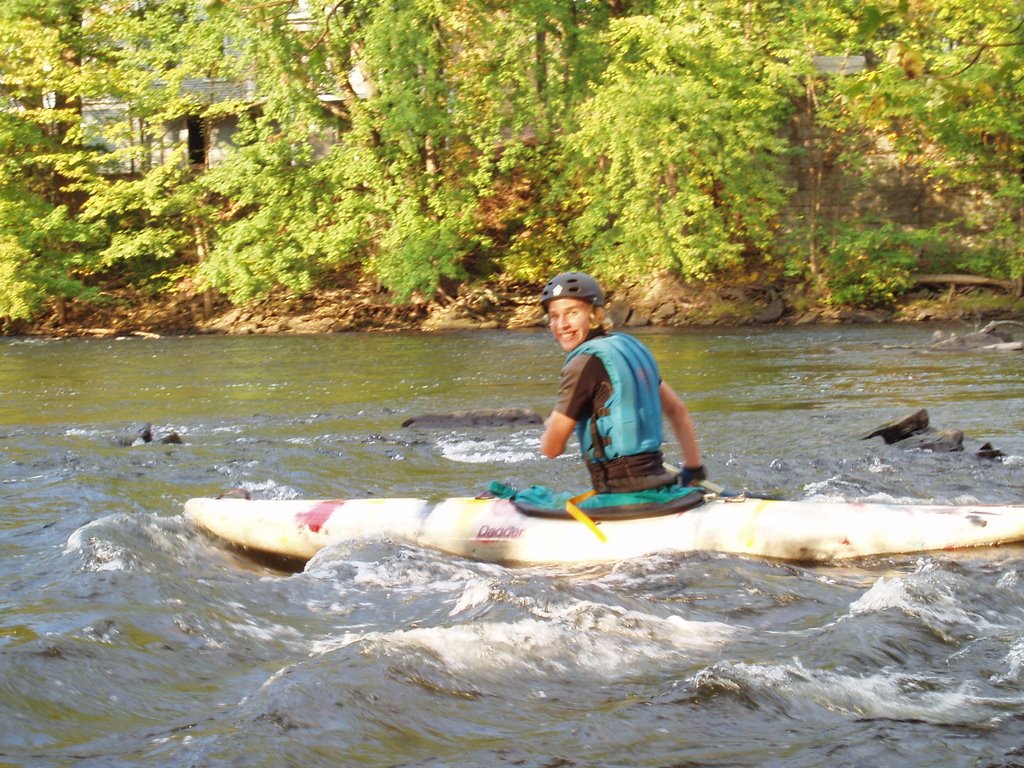
Gabe returned home from Asheville, North Carolina yesterday; he traveled south to visit his sister, Heidi. They were able to spend time with one another on the campus of Warren Wilson College, where Heidi has just entered her junior year. Gabe had an interview with the admissions office, too. But the two probably had the most fun checking out the streets, shops, and people of Asheville itself. Asheville and Warren Wilson are linked to Simsbury by a common thread. Both communities, although separated by several hundred miles, are part of a geological landscape that, in addition to supporting a typical riparian ecosystem, have some of the best whitewater boating opportunities in the East. Tarrifville Gorge here in Simsbury is recognized as one of the few continuously available whitewater runs in New England. It has been host to many competitive venues in addition to supporting lots of recreational whitewater kayakers and canoeists. So, too, is Asheville a hotbed for the sport. The French Broad and Swannanoa flows are used widely by locals and by students at the college which supports a team. Whether for competition or general recreational fun, both of these areas are, in a word, excellent!

Gabe and I spent about an hour knocking off the rust from our paddle skills and reacclimating ourselves to the different spots to ride some waves, to eddy-hop up the current, or to practice peel outs and Duffeks. A week ago this would not have been possible. With little rain for the past month, the river level had dropped well below the necessary 1000 cfs flow for good whitewater challenges. As it was, the recent rain didn't recharge the groundwater sufficiently and the increased flow of two days ago was already in decline. The link at the FRWA website, which directs the user to the USGS gauge at Tarrifville, indicated only 700 cfs, so things were a bit scratchy, but, nevertheless, fun.

We returned home tired but laughing about the potential to make a "B" level instructional film using the video capability of my little digital camera. The brief segments that we did make were of decent quality and humorous. Gabe might be right, there may be a market for humorous instructional footage to offset the plethora of dryly crafted videos hawking the sport. Maybe you will see us on the shelves someday soon?

Friday, September 29, 2006

Fish Hawk


Expect the unexpected. In the days and weeks leading up to today, I’ve been entertained by a steadfast Egret that has since moved on (South?), a skittish heron, a few awkward looking turkeys high in the oaks that arch over the river, many bluejays squawking from points unknown along the shoreline, and the gracefully darting kingfisher that zips from bank to bank with an air of irritation at my presence. But today the unexpected happened.

I rounded the first bend remembering all of the trout rises that I had observed a few days earlier. On this particularly crisp afternoon, their activity was even more pronounced and as I floated and photographed the ripples, I felt honored to be, quite literally, surrounded by their ambitious efforts to procure a meal. As I picked up my paddle and said goodbye to the trout, I heard, to my right, a loud and uncharacteristic splash.
In recent days, there has been a significant amount of splashing from acorn drops all along my mile. But this is a distinct “plunk” that has become so familiar as to approach “white noise” while I paddle along. Today’s disturbance was startling, approaching a brief commotion. In an instant, I stopped my paddle strokes and moved my head sharply toward the sound to see a large bird rising from the middle of the river. My first instinct, an Osprey, proved to be correct, but not after doubting that this might not be the case for lack of previous experience with this species here along the Farmington. The Osprey, or fish hawk – a moniker with which it is tagged by some - has an unsual and exciting predatory approach toward the capture of the fish that make the vast majority of its diet. The bird will hover almost stationary about one to two hundred feet above its quarry until ready to fold its wings and, truth be told, falls in an almost uncontrolled and quite ugly drop straight down with talons extended until, in a chaotic eruption of water, feathers, and fish, it rises up from the strike with prey clenched and wings beating furiously until satisfactory lift enables a more graceful flight to an awaiting branch and a satisfying meal.
Of course, my excited presence led to an interrupted dining experience for my friend. And my efforts to photograph her majestic form high in each successive perch failed for lack of appropriate camera lens. Never-the-less the experience was a nostaligic joy. Some twenty years ago I spent several summers working for a good friend who raised oysters in a brackish water pond on a small island off the coast of New London, Connecticut. Nesting nearby and joining our long summer days of outdoor work was a pair of adult Osprey with noisy and needy offspring. The fish hawk, like so many of the other large raptors, has a voice that is high pitched and completely out of character for such a large bird. Yet, the cry of the Osprey is one I will always be able to recognize within seconds of hearing it. I found that I could only smile at the fortune presented by this wonderful surprise.

The paddle ended just as the sun was setting and as a waxing crescent moon rose over the tops of the oak and locust trees which must be getting close to turning hue and shedding another year’s production of foliage. I eagerly await the days of October when the autumn color will bring a visual saturation to my journeys along my mile of river.

Thursday, September 28, 2006

The Paddle


After reading some poetry posted by my friend Lem, I remembered that I had written a poem appropriate for this journal. Scratching through a dusty website where I first posted this piece, I was lucky enough to have found it and leave it here for you to ponder:


From the Paddle

Dipped in liquid glass it merges,
With strength of cedar, in depths of
Untold ages before and hence.

From where this path has lead,
None shall ever see again.
But forward it pulls to other days.

And now with setting sun aglow
We move in tireless unison.
Tomorrow, lad, tomorrow,
Of water's stories shall we drink.

Maps and Dreams


Maps and Dreams. There is a book carrying that title by a man named Hugh Brody. He spent many years living and working with various native people in arctic and sub-arctic regions of Alaska and western Canada. An anthropological study, it reads like a novel as Brody's gift with explanation coupled with the beauty of the simple and harmonious life led by peoples in the high latitudes provide the kind of clarity rendered by a brutally cold January day that dawns calm, quiet, and sharp. However, his selection of a title is what intrigued me when I first read the book and what continues to drift through my head like the memory of a fond childhood friend. Adventurers love maps and use them to create dreams. Then, as the dreams are being fulfilled by the fruition of days, weeks, even years of planning, it is maps that make the adventure possible.

When I have ventured into some remote reaches of Canadian lake country, I have spent many free moments pouring over the topo maps and canoe route maps of the local area. I am fascinated by running my index finger from point to point working up a visualization of the suspected terrain, vegetation, and watercourse. I remember last summer, after returning from a week in the Adirondacks paddling some lakes and the Raquette River with my son, Gabe, spending hours retracing our route with the help of the Adirondack Canoe Country map that we purchased just before embarking in Saranac Lake. When we saw the old blue Nissan pick-up waiting in the parking lot, having been shuttled by the people at St. Regis Canoe Outfitters, the map atop my pack resting at my feet - where it had been for the past five days - was the first thing that I pulled from the canoe and carefully stashed away for the drive home. The map now hangs from the wall down in the basement with our route marked by pen.

I will never tire of the wanderlust that maps induce. I'm a traveling man and have always been on the move, either literally or in the planning, dreaming and scheming pockets of my mind. I have driven (or been driven) across the United States eleven times, spent four months sailing the Carribean, visited Mexico, Canada, and several countries in Europe. My journeys can all be traced on maps and it is the act of looking at the maps that stirs, in a nostaligic way, the fond memories of great adventures with great people.

Brody put the two concepts together with perfection - to dream is to immerse oneself in maps and the journey is not complete without the companionship of a trusted map. Already I am planning my next big adventure.


The satellite photo at the top of today's entry shows the mile of river I have been paddling each day. Look carefully at its detail and fill in the uncertainties with the stories I have shared and will continue to share through the final days of autumn.

Wednesday, September 27, 2006

Paddling with a partner today.


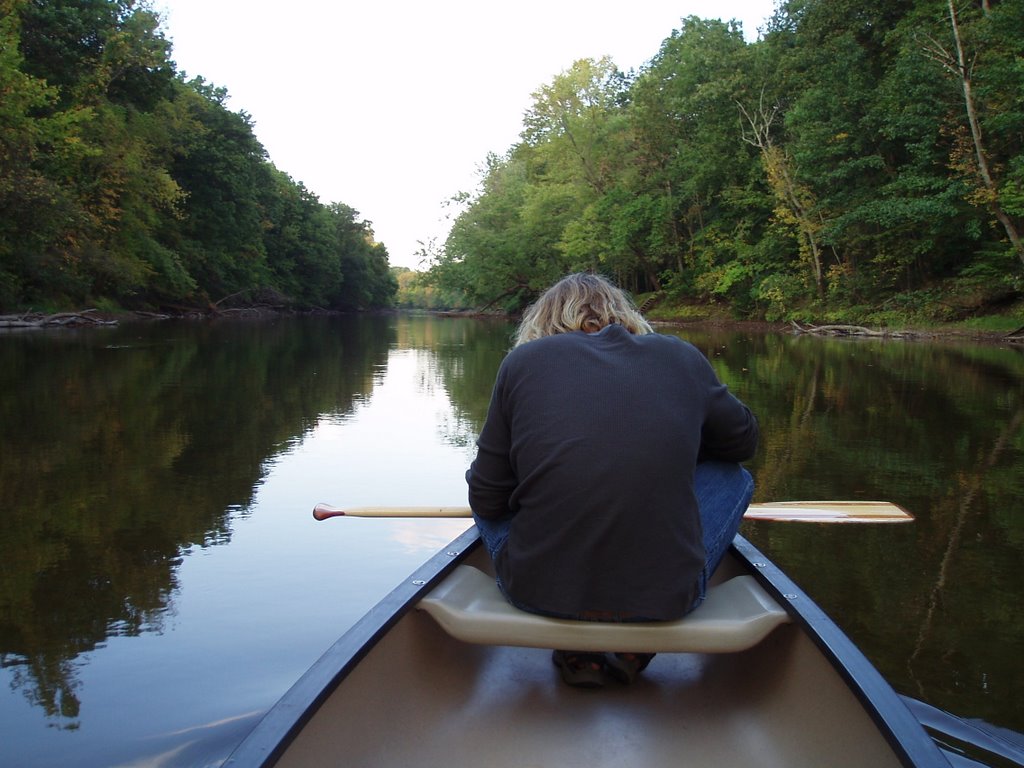
I had a partner today. Gabe, my son, and I have paddled many interesting and fun waterways together. All told, we have probably logged about 250 miles together on the Farmington, the Housatonic in western Connecticut, and up in the Adirondacks last summer for a weeklong trip from Saranac Lake to Tupper Lake. He is a great canoe partner. I count myself lucky to have had many great bow people over the years. Through the tough portages and unpredictable white water along with laughs during more relaxing times on flat water floats, it has all been grand.


I asked Gabe to come with me today so that we could explore an area of the river bank that must have served as a dump for one of the local farms. Along a stretch of shore about three hundred yards long one can find an array of old rusted wheels, bed frames, buckets, and other non-descript items that have been corroded past the point of any collectible value. The real find in the shallows, covered with silt, but still awaiting discovery, are dozens of old bottles. Within a span of about one hour, in fading evening light, Gabe and I pulled out about two dozen intact bottles of varying vintages.


It was a great pleasure to see Gabe become so interested in this type of adventure. Beyond the thrill of finding a bottle that is not cracked or broken and which can be quite old, the real attraction is the potential history lesson that comes up from the river bottom with each piece. With a little time and effort scrubbing the years of silt and algae deposits from the glass surface, I should have a fairly interesting and worthy collection of glassware from fifty to one hundred years old.

I am intrigued by the history of that farm and plan to delve deeper into the mystery by checking some documents at the local historical society offices. The river had a very different look and feel one hundred or so years ago and it will flavor my journeys considerably if I am better informed about the unique characteristics of spaces that hold the river in place. Today the river was made lively by the presence of my wonderful son and our mutual interest in the bottle hunting and in good idle humor to fill the spaces between paddle strokes. People make these meetings with the river just as interesting and exciting as the flora and fauna that are a constant surprise with each paddle.

Monday, September 25, 2006

Today - a workout.


I drove another mile down the road to a different put-in today. With a beautiful fall day and two hours of crisp autumn afternoon to engage, I decided to give myself a workout by paddling two miles instead of my usual one. I jumped into my '89 Nissan pick-up (a faded gray/blue bucket with more rust underneath than some of the old steel cans I see along the river banks) after grabbing paddle, spray skirt, and PFD, having already strapped the Walden kayak into the bed. Within a few minutes I found myself waiting for a car to pull out of the small steep drive into the parking area as dozens of commuters coming home from Hartford passed by on my left.

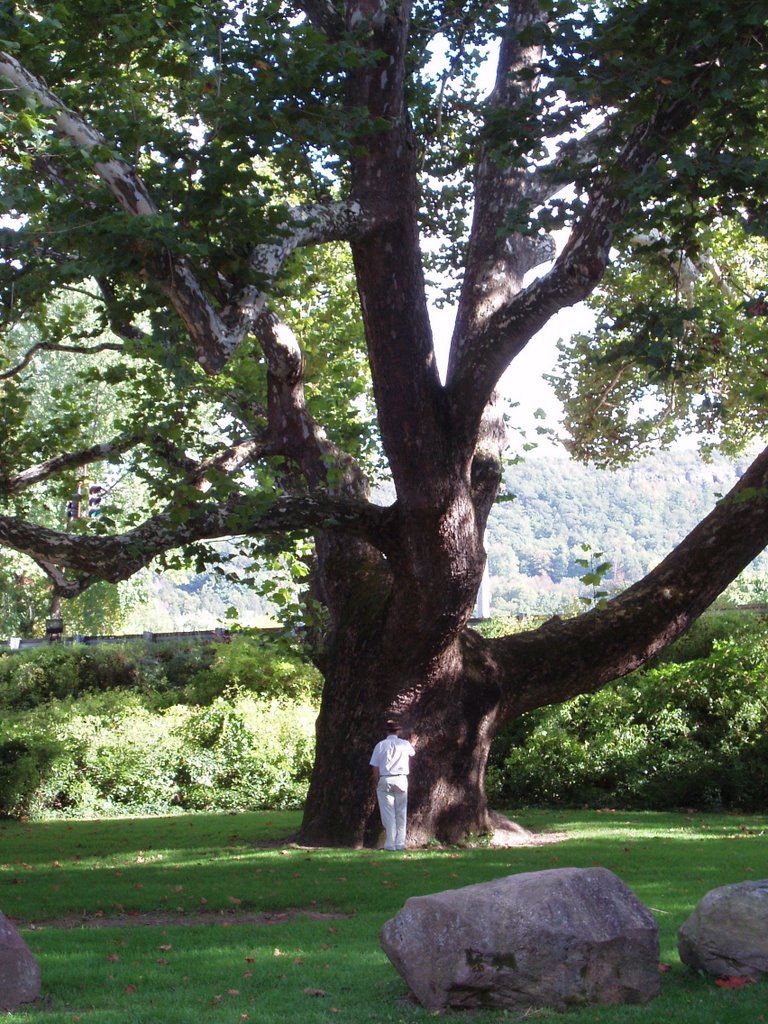
Here by the side of route 185 which leads into the capital city after rising up over Talcott ridge is the largest tree in the state. The Pinchot Sycamore is a massive living being with a girth that rivals redwoods and a canopy spread that is as wide as the tree is tall. I'd been thinking about starting my paddle here for several days as I thought that I needed to pay a private tribute to this wonderful giant. The man standing by the tree in the photograph came down to water's edge after seeing my bumper sticker touting the sanctity of returning salmon to the Farmington. The Farmington River Watershed Association is working hard, among other heroic efforts, to support a salmon fry release program each spring with the aid of the Connecticut Department of Environmental Protection. He and I chatted about salmon briefly - he had recently returned from visiting the Klamath River in Oregon. We both have concerns about the human impact on important and valuable rivers like the Farmington. I had mentioned that the FRWA had conducted a build-out survey in the town of Farmington recently which evaluated the quantity of impervious surface in the town. Man-made structures through which rainwater cannot percolate are one of the greatest threats to rivers. Excessive run-off leads to erosion issues during higher than normal flooding, and then poor groundwater recharge leads to unusually low water levels during dry spells. As I paddled away, he mentioned that he wished he had brought his canoe.


I finish my workout in a fresh breeze that made the day seem so very different from just forty minutes before when I slipped into the shallows by the sycamore under sun and in calm air. Then I smiled as I remembered that every meander offers a surprise - welcome or not.

Sunday, September 24, 2006

To each his own....


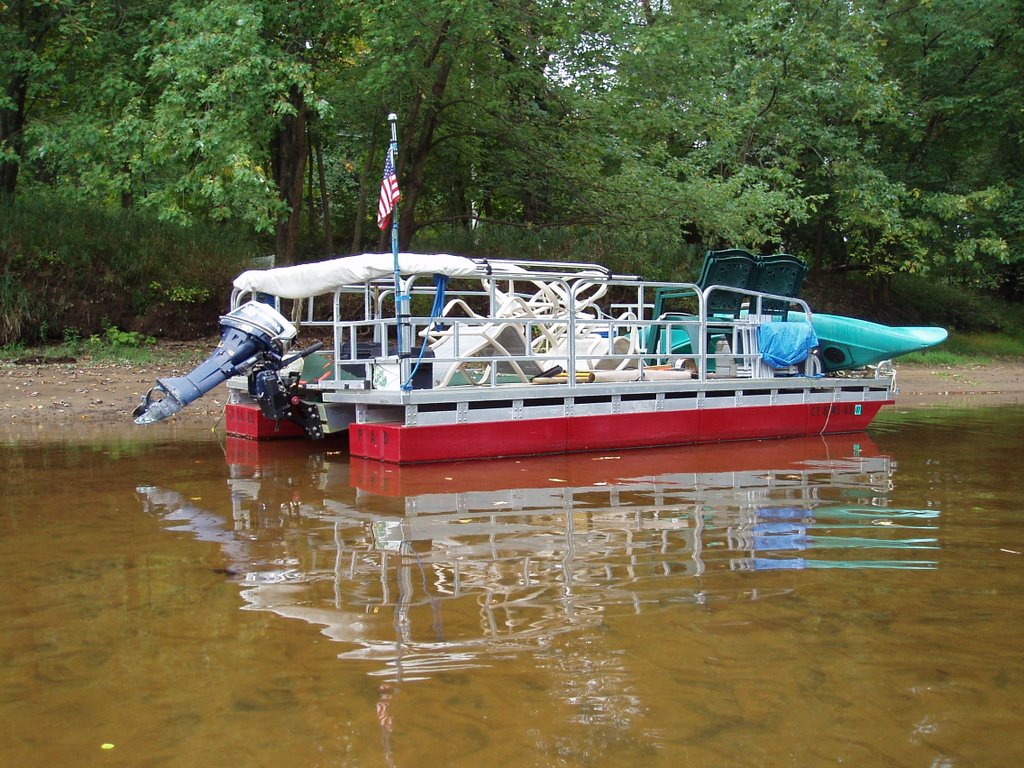
To someone, she's a beauty. I've seen this pontoon boat tied up each day that I have paddled. Just down river from the town boat dock where I put in, this fully outfitted vessel does not seem to have moved much in the past month. And while I am sure that I would enjoy an afternoon steaming up and down the banks of the river through Simsbury, Avon, and, perhaps, as far south as Farmingtion, fishing, tossing back a few beers, and having a few laughs with good friends, she's just not my kind of ship. Even my ten foot Walden kayak in which I have been running my mile of river almost exclusively is not my favorite slice of boating design. To me, the perfect vessel in any water is the canoe.

Whether for a short day trip with good company, or in the hands of a guide and a group of six or seven tripping canoes in wilderness waterways, this ancient craft is near perfect in design, functionality, and joy of paddling. Just compare the orientation of the paddlers to one who prefers to row a boat. I learned how to control watercraft in a small rowboat and was skilled enough to help teach other campers during my years as a young adolescent at Camp Mi-te-na in Alton, New Hampshire. Yes, rowing is an art and a pleasure. However, you are forever having to look over your shoulder to make sure that your heading is still in line with the intended bearing. In a canoe, one can always see ahead and to the sides of the planned route. The stern paddler can, with a quick adjustment of stroke, make quick maneuvers that would never be possible in any type of craft that is rowed with oars. In addition, the techniques and adjustments that can be made with a paddle far outnumber any tricks with the bulky oars in a rowboat.

I paddle because I love to be on the water. Yet, my love for the water brings me into contact with the feel and grace of the paddle which is an even deeper passion. I can recall many days in Canada, after hours in dry heat or steady rain, feeling as though the paddle and my subtle course adjustments have become a part of my muscle and sinew. But a pontoon vessel may be bringing just as much excitement to the heart of my friend whose craft sits patiently along the banks of the Farmington in the late evening glow before sunset.

I won't begrudge a man for his choice in craft - to be on the water and down the river affects anyone regardless of personal preference in vessel. I will say, though, that the quiet trickle of water off a paddle leaves little room for improvement when all is said and done.

Saturday, September 23, 2006

Afloat


The first day of fall has arrived as it has, for me, 46 times before. Celestially, the day does, indeed, have significance. But to the casual observer, to the maples, oaks, and locusts that line the river, to the heron, egret, painted turtle, beaver, and largemouth bass that I have watched with intent these past few weeks, this day is but a continuation. The long light of summer days has waned and the internal signals of preparation hasten. Winter will be here quickly. With it will come bitter cold, wind, storms, ice and darkness. But before everything becomes locked in the grip of January and February, we have the welcome chill and firey color of October to witness.

I arrived at the put-in today and was followed almost immediately by an elderly gent in his convertable Triumph. I noticed as soon as he switched off his ignition that he was listening to Bruce Sprinsteen singing about his hometown and it got me to thinking. Gladwynne, Pennsylvania; Boxford, Massachusetts; Concord, New Hampshire; Middletown, Rhode Island; Claremont, California; Durham, New Hampshire; Philadelphia, Pennsylvania; Simsbury, Connecticut - all places that I have lived for more than year - which is home? What IS home? To me it's more of a feeling than a place. Home is the river, woods, an open field in late afternoon light, beaches where the sea takes back what comes from the highest peaks are all more like home to me than some dwelling on a street with a number and a name.

This morning I awoke in Dublin, New Hampshire. I was there to see my younger brother who has been away from his home - his wife and three young boys - for the better part of the summer. He will be there - in his hometown - until tomorrow when he flies back to Fort Riley in Kansas to prepare for his trip to Baghdad with his army unit for a year of service, work, conflict(?), and, hopefully, fast days and nights leading to a return home - safe and sound - a return to being a father, a husband, a town manager, and a friend to other hometown people.

Does a hometown keep one afloat? And what about me - feeling as though no town is HOMETOWN? Does my time on the river, literally afloat in the hand of the buoyant water beneath, represent home for me? It feels that way. Sane, secure, relaxed, and able to think clearly and with a freshness that is difficult to find at a desk pushing pages and papers, I am at home on the river, along the trail, sitting on a log listening to the white-throated sparrow calling to me to settle where I am at that moment.

Springsteen's craft with words and notes was able to elicit many thoughts this first day of autumn. I'm into this journey now and it is apparent that it will bring something new each day. I know this because I have seen the changes a New England autumn can bring. I have seen them more than forty times. The adventure lies in what appears each moment as the river meanders into time that awaits ahead.

Friday, September 22, 2006

Put-in


For the river people among you, the trekkers, those who have been "out there", the ones who get away "to smooth it, cause its rough enough back in the city", you know the term put-in as though it were an old friend. We put-in to begin it all. The place to which we arrive where the transition from coat and tie, dirt on the back, grit under the nails, gives way to the deep breath that fills the lungs with air that seems to be spiced with extra oxygen. A put-in is the point from which any adventure begins.

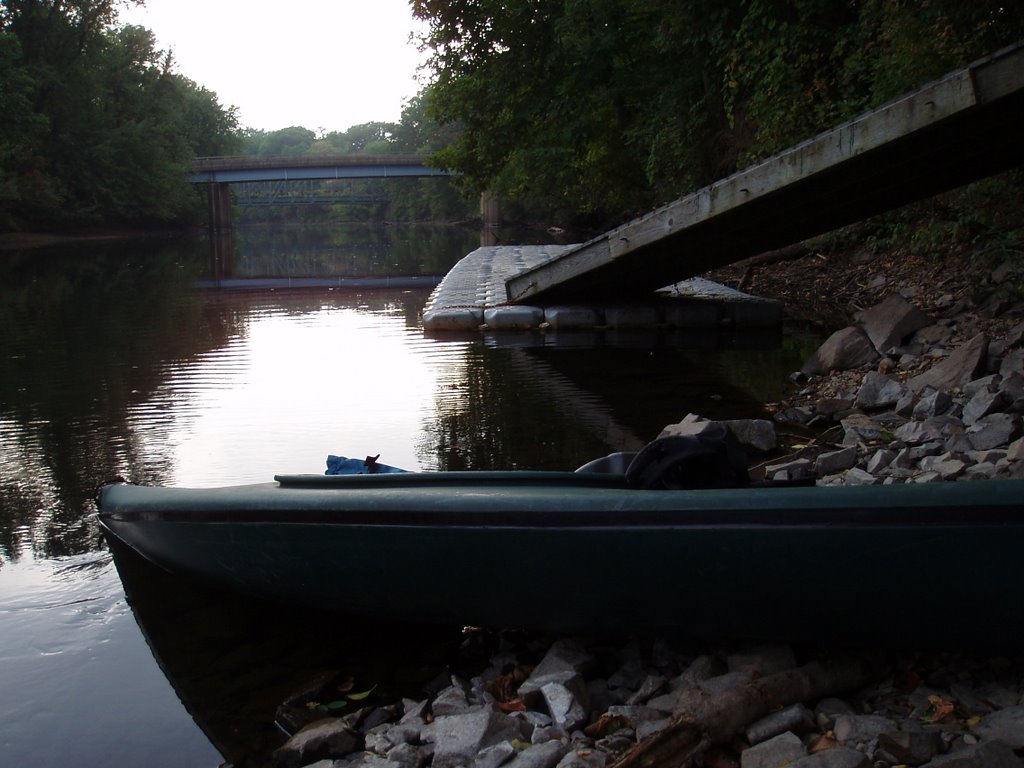
My mile of river offers an interesting mix of metaphors and reality at the put-in. I borrow the town facility that supports the local rowing club which is growing by the year in interest and capital. Simsbury is a town that loves its youth sports and the crew club is no exception. The local high school has a team that competes in this region of New England and the program has, by my daily observation when I paddle in the afternoon, extended down into middle school-aged children and upward into the adult population with considerable success. Today when I left my truck in the parking area and lugged the kayak and gear across the front of the open boat house toward the floating dock, I gazed into the facility to see no fewer than fifteen high-tech composite "shells", as crew vessels are known. Out on the pavement were a dozen or so ergometers - rowing machines - each supporting the energetic bodies of some of the local youth.

It makes me smile to know that so many people are getting themselves fully immersed in the Farmington River. Its a wonderful resource and such a fantastic way to escape for a few minutes or hours when the long term adventure is not possible.

My put-in is also the discharge location for the sewage treatment facility in town. The pipe that deposits thousands of gallons of treated wastewater each day is actually just below the boat ramp. One can see the discharge when river levels are low. I've taken my environmental science students on tours through the facility to let them know that, despite the unnatural intrusion on the river and its life, contemporary technology has led to much less impact than was the case a few decades ago. Due to legal action and general concern about the impact of Connecticut and New York municipal wastewater upon Long Island Sound, towns have been upgrading their facilities to remove nutrients that continue to pose a threat. Simsbury's facility has been getting this much needed upgrade and face-lift for the past two years and, through conversations with some of the workers in the parking lot, a good year of work is yet to come.

So, I think of many things as I settle into the tight cockpit of my kayak, snap the spray skirt around the coaming, and push off from the shoreline. Thoughts that are buoyed by youthful spirit and thoughts that are grayed by concern for what has been lost. In the days ahead, I'll try to pay more attention to reconciliation of this conflict.

Thursday, September 21, 2006

A Turn in the Weather


We are still many days away from a visit by the north wind, but the air has changed overnight and the day was crisp, bright and dry. A trip to the river today was more than a compelling respite from a busy day, it was as though the air sent the invitation up the hill toward my office. Later, when on the water, the air took me back to visits to lakes and ponds when I was young. Waters in New Hampshire that drew me to their mysteries are still vibrant recollections. Its a combination of smell and feel more than a vision - that's what always takes me back. The mysteries were composed of unseen fish below the surfaces, ripples in the distance from unknown sources, and sounds left unrevealed even with a turn of the head.

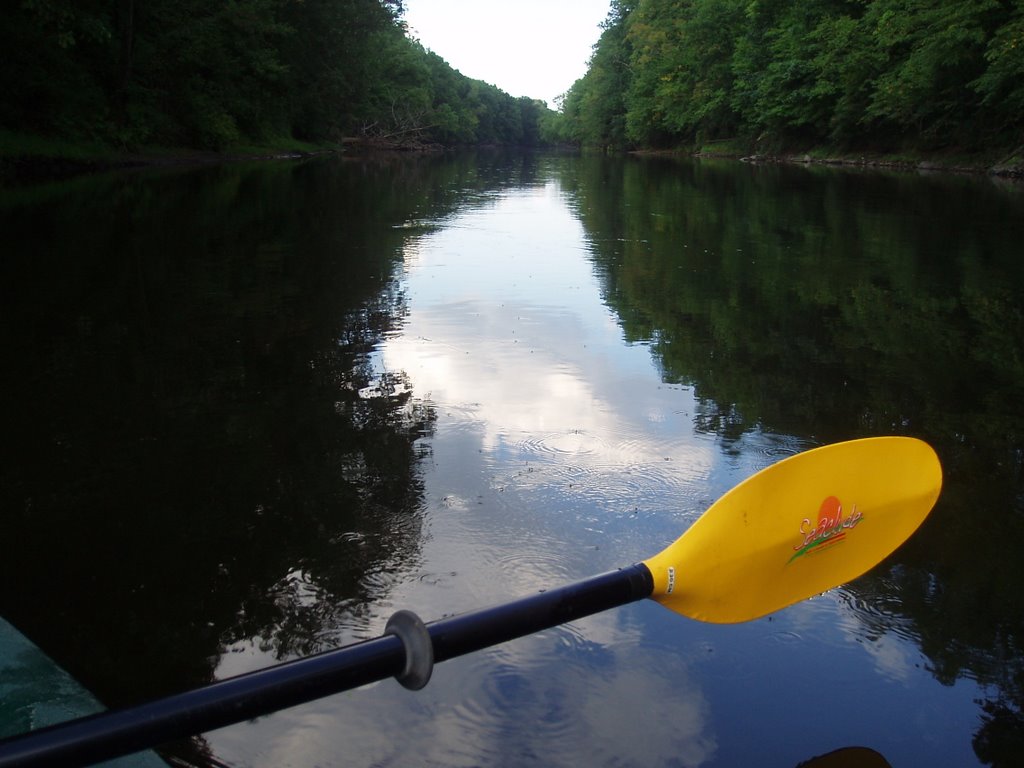
The river today was calm, quiet and a warm red in the late afternoon light. Paddling was an easy affair and I found myself readily engaged in trying to capture with camera the stoic solitude of a great blue heron which I found standing on a pile of floatsam on the sunlit river bank. The bird was unusually patient with my presence. Approaching any wildlife while paddling, I am always conscious of the flashing yellow blades of my paddle. The heron was not perturbed and it took several minutes of my nusiance observation and photography before it had had enough. Off it flew the short distance to the other side of the river to take up, once again, its search for small fish in the shallows.

The equinox is less than forty-eight hours away and the paddling will bring many stories. I look forward to the waltz of the fallen leaves in the eddies, the crisp breezes and shorter days of late October, and the promise of a paddle in an early winter snow squall after sunset on a late November evening. Perhaps some new adventure that the river hasn't yet revealed will find me by December. I'll stay alert to the possibilities with every bend in the river.

Sunday, September 17, 2006

Inspiration


On a shelf by my desk down in our finished basement is an old, well-worn copy of "Autumn Across America" by Edwin Way Teale. A prolific writer and naturalist, Teale wrote several volumes about lengthy trips that he undertook, in the company of his wife, across various stretches of the United States. With a novelist's eye for detail, a warm, congenial approach to the local inhabitants, and a passion for birdlife, Teale uses his words to reach out, grab your hand, and tug you along every highway and dirt road he wanders.

Inspired by Teale's concept for enlightening the hearts of the common woman or man, I wanted to create a similar journey. My journeying being limited by my employment as a teacher, I conceived of a plan to paddle a one mile stretch of the Farmington River each day this autumn and to write these notes on a daily basis as they become apparent to me by my experiences.

The Farmington River is an amazing stretch of water that rises in south-central Massachusetts and winds its way south into the rural regions west of Hartford in Connecticut. Due to geologic change during the past ice age, the river bends sharply to the North in the town of Farmington, passes through Avon and Simsbury as a placid flow and then hurtles through a gap in the Talcott Ridge before discharging its waters into the Connecticut River in the town of Windsor.

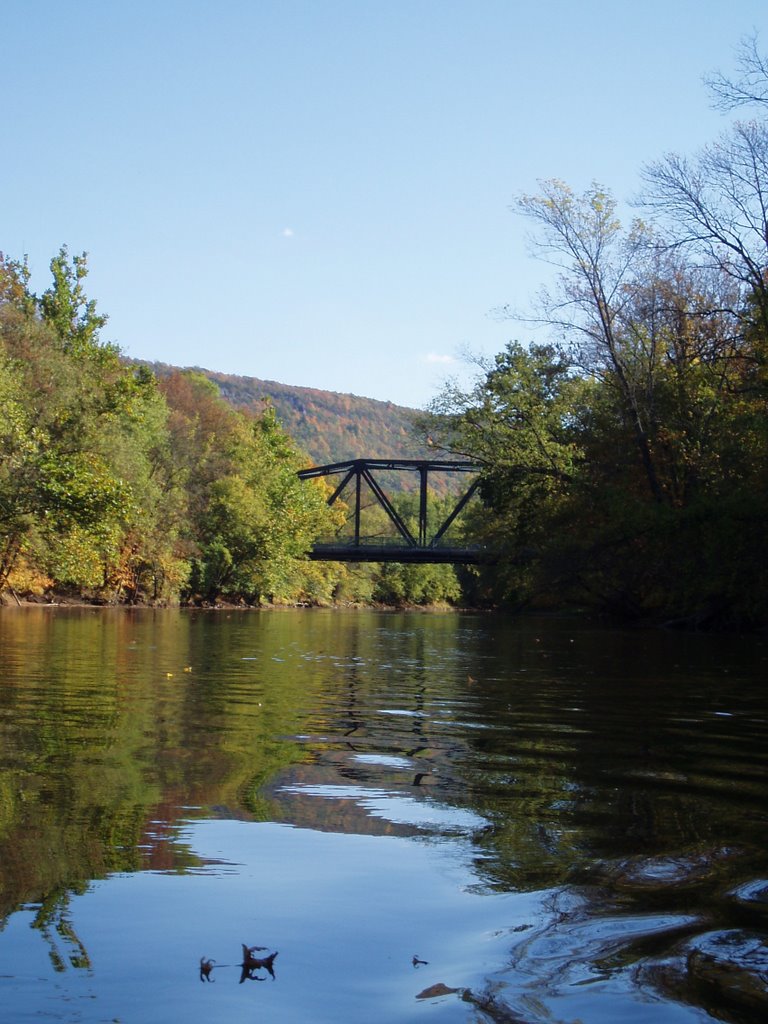
I live in Simsbury in a small home separated from the river by Hopmeadow Street and the bicycle path that was once part of a passenger/freight rail system that ran through this part of the state. I can walk out my door and be down by the water within a few minutes. The river's influence in this town is significant. It bisects Simsbury in a north/south direction and is crossed by only four bridges within the town limits. When the river floods, town athletic fields are submerged, a few local farms are impacted, and, occasionally, some short stretches of road become impassable. Many residents cross the river twice each day on their daily commute into Hartford, and most have spent some time either on the river or alongside its banks enjoying the various New England seasons.

I hope to post a few photos each day along with my musings about the sights, sounds, and smells of each paddle. I welcome comments and even requests that might emerge as the story unfolds. Autumn is at my doorstep, the harvest moon is on its way, and a mile along an American river is about to become a day-to-day adventure.